
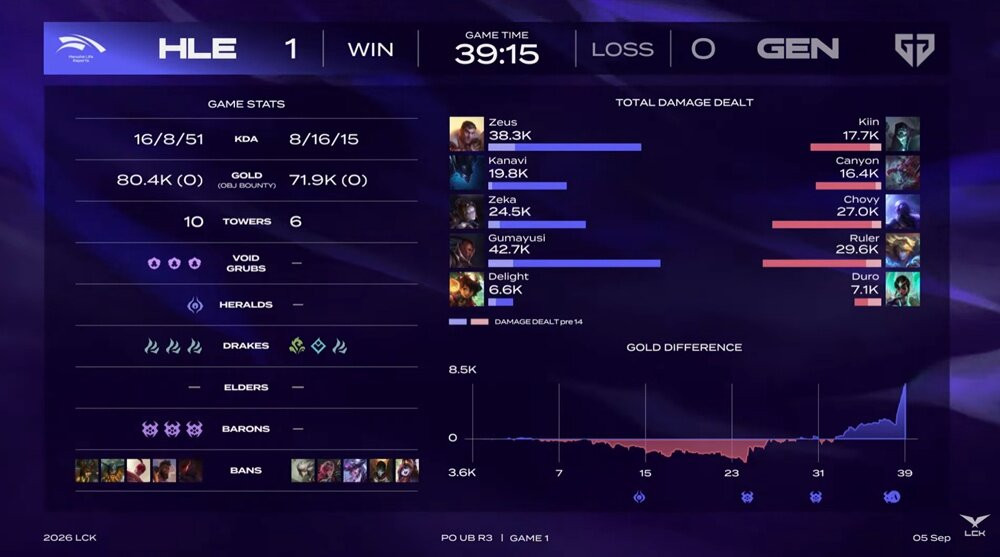
On the 5th, Hanwha Life Esports took Game 1 against Gen.G in Round 3 of the Upper Bracket in the ‘2026 LoL Champions Korea (LCK)’ Playoffs held at Chzzk LoL Park in Jonggak. ‘Zeus’ delivered a brilliant performance on Jayce, demonstrating immense firepower in every fight.
In Game 1, Hanwha Life Esports blew all of ‘Chovy”s Ryze Summoner Spells early on while also pressuring Gen.G’s bot duo. In response, Gen.G’s ‘Canyon’ on Cho’Gath secured ‘Gumayusi”s Lucian with good gank timing and skillful ability usage, before taking the first Dragon. Cho’Gath then headed back to the bot lane, hit Milio with Rupture, and used Flash and his ultimate to eliminate Milio and build stacks.
Hanwha Life Esports also scored results, such as ‘Kanavi”s Nocturne picking off ‘Ruler”s Ezreal during his ultimate window, but Gen.G consistently secured Dragons to reach three stacks. The two teams then engaged in a major teamfight in mid, where ‘Zeus”s Jayce took down ‘Duro”s Karma through poke. The two sides were evenly matched—at the 30-minute mark, the kill score was tied at 8:8 and there was no gold difference at all. Amid the intense tension, Hanwha Life Esports picked off Ezreal near the enemy blue buff and followed up by taking both Dragon and Baron.
With the Baron buff, Hanwha Life Esports pushed the bot lane and destroyed the inhibitor. In mid, Gen.G initiated a fight first with ‘Chovy”s Ryze ultimate, but Chovy became exposed to danger instead, and Hanwha Life Esports cut down Ryze. Hanwha Life Esports then rallied to Baron first, killed the objective, won the subsequent teamfight, destroyed Gen.G’s Nexus, and took Game 1.
[Read Original]
PakarPBN
A Private Blog Network (PBN) is a collection of websites that are controlled by a single individual or organization and used primarily to build backlinks to a “money site” in order to influence its ranking in search engines such as Google. The core idea behind a PBN is based on the importance of backlinks in Google’s ranking algorithm. Since Google views backlinks as signals of authority and trust, some website owners attempt to artificially create these signals through a controlled network of sites.
In a typical PBN setup, the owner acquires expired or aged domains that already have existing authority, backlinks, and history. These domains are rebuilt with new content and hosted separately, often using different IP addresses, hosting providers, themes, and ownership details to make them appear unrelated. Within the content published on these sites, links are strategically placed that point to the main website the owner wants to rank higher. By doing this, the owner attempts to pass link equity (also known as “link juice”) from the PBN sites to the target website.
The purpose of a PBN is to give the impression that the target website is naturally earning links from multiple independent sources. If done effectively, this can temporarily improve keyword rankings, increase organic visibility, and drive more traffic from search results.
